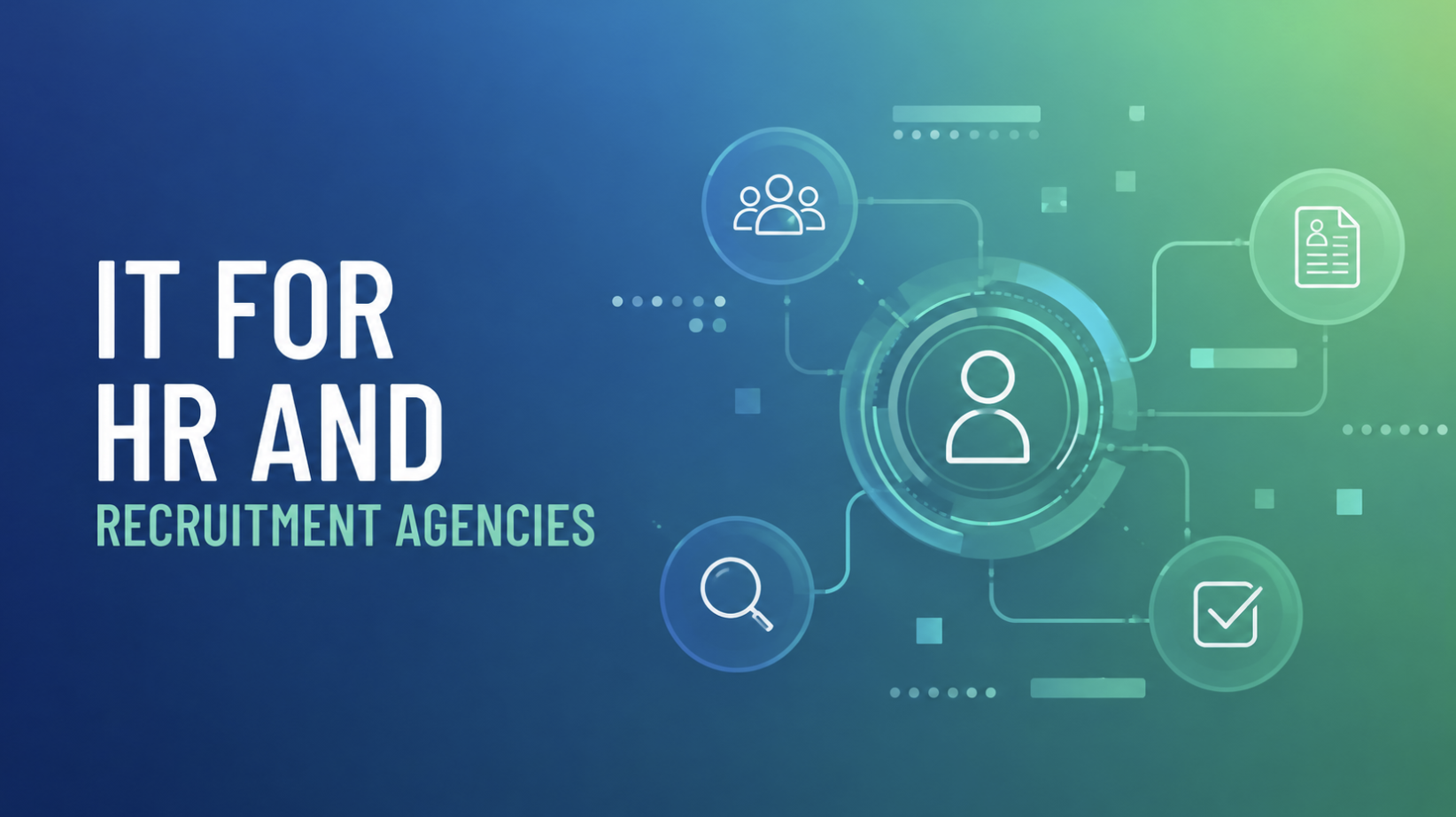
IT for HR and recruitment agencies is the technology foundation these businesses rely on to source candidates, manage sensitive personal data, and place people quickly and securely. Because a recruitment agency processes large volumes of highly personal information – CVs, identity details, references, and salary expectations – its IT setup carries a heavier data protection burden than most businesses of the same size. Strong IT in this sector combines the right tools, strict data protection, and reliable security so recruiters can work fast without putting candidate data at risk. This guide explains what matters most and how to get it right.
Why Is IT So Critical for HR and Recruitment Agencies?
Because the business runs almost entirely on data and speed. Recruiters handle hundreds of candidate profiles at once, respond to opportunities within hours, and often work from client sites or on the move. Any downtime, data loss, or breach directly affects placements and client trust.
Three factors make this sector especially demanding:
- High volumes of sensitive data. Candidate records contain identity details, work history, and sometimes salary or health information, all of which fall under strict privacy rules
- Speed is a competitive advantage. The first agency to present a strong candidate often wins the placement, so slow or unreliable systems cost real revenue
- Constant inbound attachments. Recruiters open CVs and documents from unknown senders all day, which makes email a prime entry point for attackers
What Is an Applicant Tracking System (ATS)?
An Applicant Tracking System (ATS) is the central software a recruitment agency uses to collect, organise, and track candidates throughout the hiring process, from first application to placement.
An ATS is used when an agency needs to manage many candidates and vacancies at once without losing track of who applied for what, and wants to search, shortlist, and communicate from one place.
Because the ATS holds the agency’s most valuable and most sensitive data, it deserves the same protection as any core business system: controlled access, reliable backups, and a clear agreement with the software vendor on where and how the data is stored.
How Do You Keep Candidate Data GDPR-Compliant?
By treating candidate data as the regulated personal data it is. Under the GDPR, an agency must have a lawful basis to process candidate information, keep it only as long as necessary, and protect it appropriately. Because recruitment involves collecting far more data than most businesses, these obligations carry extra weight.
The compliance checklist covers:
- Lawful basis and consent. Make clear to candidates why you hold their data and how long you will keep it
- Retention limits. Set a policy for how long candidate records are stored, and delete or anonymise them once that period ends
- Access control. Give each recruiter access only to the candidates and vacancies they need
- Data processing agreements. Sign an agreement with every supplier that processes candidate data on your behalf, from your ATS vendor to your IT partner
- Candidate rights. Be able to provide, correct, or delete a candidate’s data on request without unnecessary barriers
How Do You Protect Against Email and Attachment Threats?
By combining technical filtering with trained staff, because recruiters are unusually exposed. They open attachments from strangers constantly, and attackers exploit exactly that habit by disguising malware as a CV or hiding phishing links in fake job applications.
The email security checklist includes:
- Advanced mail filtering. Filter out malware, phishing, and spam before messages reach the recruiter’s inbox
- Multi-factor authentication (MFA). Protect every mailbox and login with a second verification step
- Security awareness training. Teach recruiters to spot fake applications and suspicious attachments, ideally with regular phishing simulations
- Endpoint protection. Run threat-detection software on every device so a malicious attachment is caught if it slips through
Which Collaboration Tools Support HR and Recruitment Teams?
The tools that let recruiters share candidates, coordinate with clients, and work together without scattering data. A platform such as Microsoft 365 brings email, files, and communication under one secure identity, which suits a fast-moving, collaborative team.
The collaboration checklist covers:
- Central file storage. Use SharePoint for shared candidate documents and client files rather than personal drives
- Team communication. Set up Microsoft Teams for internal coordination and client meetings in one place
- Shared calendars. Coordinate interviews and client appointments across the team
- Integration with the ATS. Connect email and calendar to the ATS so candidate communication stays in one record
How Do You Enable Secure Remote and Mobile Work?
By giving recruiters secure access to everything they need from anywhere. Recruiters frequently work from client offices, job fairs, or home, so they need the same access on the move as at their desk, without weakening security.
The mobility checklist includes:
- Secure remote access. Provide encrypted access to systems and files from any location
- Managed mobile devices. Enrol laptops and phones in endpoint management so they can be secured and remotely wiped if lost
- Cloud-based tools. Use cloud applications so recruiters reach candidate data and the ATS from any device with an internet connection
Where Should an Agency Host Its Data?
Somewhere secure, compliant, and firmly under the agency’s control. Because candidate data is sensitive personal data, where it physically lives matters. For a Belgian agency, hosting data in Belgium keeps it under EU jurisdiction and simplifies GDPR compliance.
Cloud hosting is the practice of running your systems, applications, and data on managed infrastructure instead of on hardware in your own office. The main options are:
- Public cloud. Rent resources from a provider such as Microsoft Azure, which scales instantly with no upfront hardware
- Private cloud. Run dedicated infrastructure – often in a Belgian datacenter – for predictable costs and guaranteed data sovereignty
- Hybrid cloud. Combine both, keeping sensitive candidate data on private infrastructure while using public cloud where flexibility matters
A practical approach hosts sensitive candidate data on Belgian infrastructure for sovereignty and predictable cost, while using public cloud where scaling matters most. An IT partner that operates its own Belgian datacenters can host, secure, and manage this environment so the data never leaves the country.
Why Work With an IT Partner That Understands the Sector?
Because HR and recruitment combine sensitive data, strict retention rules, and a need for speed that calls for specific expertise. A partner who knows the sector translates those demands into concrete choices and takes the technical worries off your hands, so recruiters can focus on placing people.
A good partner does three things especially well. First, it designs the environment as a whole, so the ATS, email, collaboration, and security work together instead of clashing. Second, it secures everything from day one – MFA, backups, mail filtering, and clear access rules – which matters enormously when you hold this much personal data. Third, it takes ongoing management and support off your plate, so a single dedicated contact handles the technology while you grow the agency. As the business scales, adds recruiters, or opens a second office, a partner that already knows your setup expands it smoothly rather than starting over.
FAQ
What is the most important IT priority for a recruitment agency?
Protecting candidate data. Because agencies hold large volumes of sensitive personal information, GDPR-compliant data protection – access control, retention limits, backups, and email security – is the foundation everything else builds on.
What is an Applicant Tracking System (ATS)?
An ATS is the central software an agency uses to collect, organise, and track candidates throughout the hiring process. It holds the agency’s most sensitive data and therefore needs strong access control, reliable backups, and a clear data agreement with the vendor.
Why are recruitment agencies a target for cyberattacks?
Recruiters open CVs and documents from unknown senders all day, which makes email a prime entry point. Attackers disguise malware as a CV or hide phishing links in fake applications, so mail filtering, MFA, and staff training are essential.
How long can a recruitment agency keep candidate data?
Under the GDPR, only as long as necessary for the purpose it was collected. Agencies should set a clear retention policy and delete or anonymise candidate records once that period ends, and be able to honour candidate requests to access or delete their data.
Where should a recruitment agency host its candidate data?
For a Belgian agency, hosting data in Belgium keeps it under EU jurisdiction and simplifies GDPR compliance. Public cloud scales instantly, private cloud in a Belgian datacenter gives predictable costs and data sovereignty, and a hybrid approach combines both depending on how sensitive the data is.