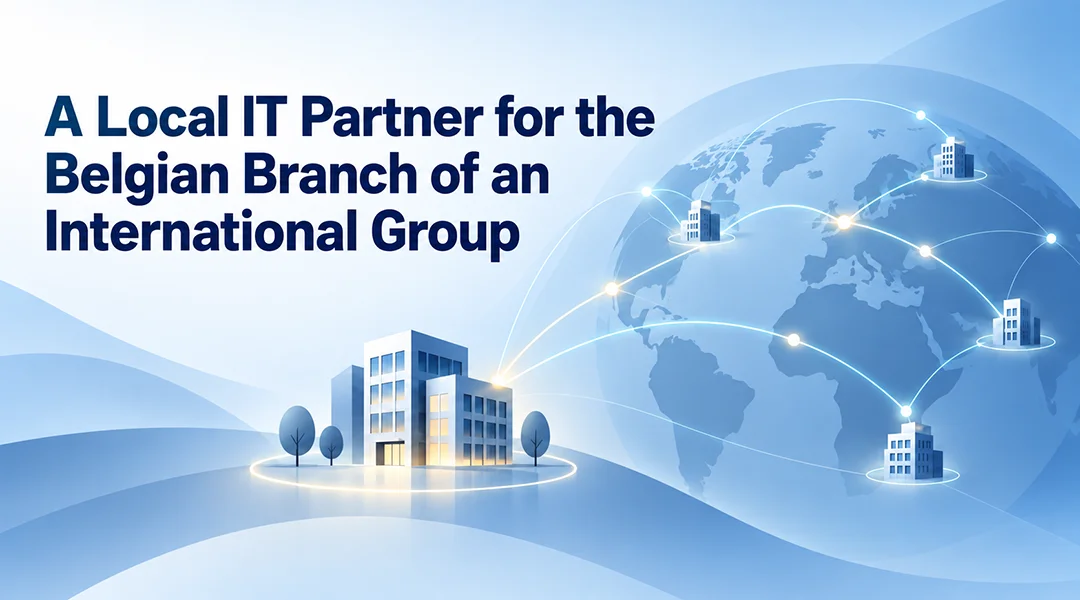
If you’re running the Belgian branch of an international group, IT is rarely as simple as “just follow what head office does.” Global policies and tools are usually decided elsewhere, but the day to day reality, a new employee who needs a laptop tomorrow, an internet line that needs fixing, a printer nobody can connect to, still has to be handled locally. That’s usually the point where branch managers or regional IT leads start looking for a local IT partner.
This post looks at why that matters and what to check for.
Why a global setup usually isn’t enough on its own
Head office IT teams are good at setting standards: which security tools to use, which cloud platform, which policies apply everywhere. What they’re often not built for is:
- Sending someone on-site in Belgium when a network switch fails or a new office needs cabling.
- Supporting a team that works in Dutch or English day to day, not just the corporate language used at HQ.
- Reacting quickly to a local issue instead of going through a global ticketing queue in a different time zone.
- Dealing with local telecom providers, hardware suppliers or specific Belgian compliance requirements.
None of this replaces the global IT strategy. It sits underneath it, handling the local layer that head office simply isn’t close enough to manage well.
What to look for in a local IT partner
If you’re evaluating options for your Belgian branch, these are the practical things worth checking.
- Can they actually show up on-site? Not just remote support, but engineers who can be physically present when it matters.
- Can they work alongside your global IT setup, not against it? A good local partner fits into the security tools and policies your head office has already chosen, rather than trying to replace them.
- Do they offer clear response times? Ask for actual numbers, not vague reassurances, ideally backed by a service level agreement.
- Can they scale as the branch grows? A five person office today might be thirty people in two years. Your local partner should be able to grow with you.
- Have they worked with international companies before? Experience supporting other branches or subsidiaries is a good sign they understand the balance between local needs and global structure.
A hybrid setup is often the most practical one
You don’t need to choose between “everything managed from head office” and “everything handled locally.” Most international branches end up somewhere in between: global policies and core tools stay centralised, while a local partner takes care of on-site support, day to day helpdesk, hardware, local connectivity and hands-on troubleshooting. This keeps the branch aligned with group standards while making sure someone is actually reachable, and available on-site, when something breaks locally.
How ITAF can help
ITAF is a Belgian IT partner with offices across Flanders, Brussels, Antwerp and Ghent, and already supports a number of international and European organisations with their Belgian operations. In practice, that means bilingual IT support (Dutch and English), on-site engineers who can respond quickly across the country, and 24/7 monitoring so issues get caught before they turn into downtime. ITAF handles the local layer, from helpdesk and hardware to network management, Microsoft 365, cybersecurity and cloud infrastructure, while fitting in around the tools and policies your head office already has in place. If your Belgian branch needs a partner who understands both the local reality and the fact that you answer to a bigger structure abroad, that’s exactly where ITAF fits in.