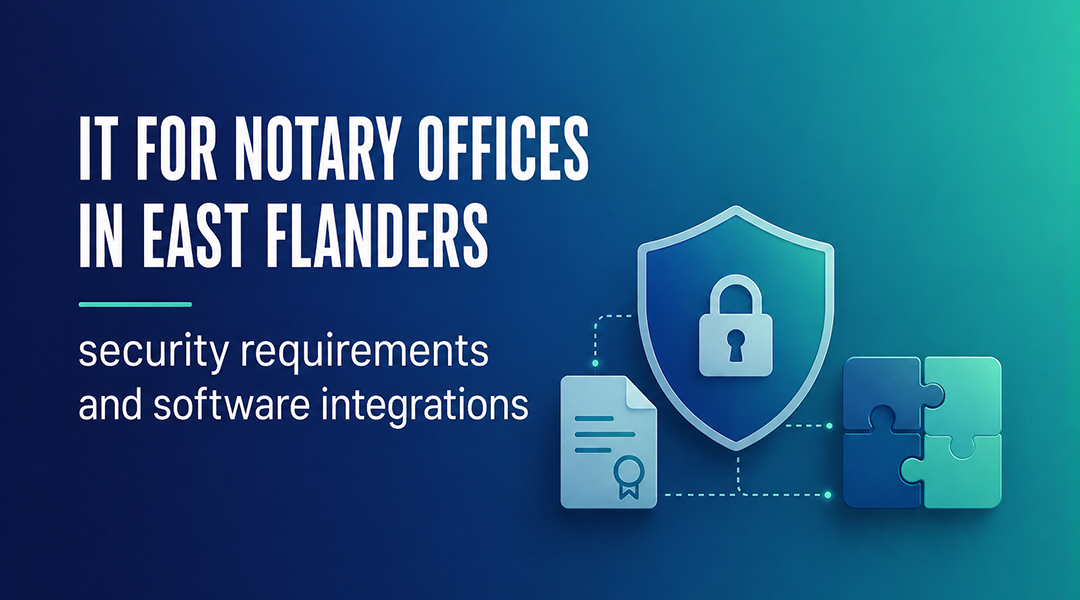
A notary office is, from an IT security perspective, one of the highest-risk working environments in professional services. Notaries manage deeds, wills, marriage contracts and financial transactions. These are documents with severe legal and financial consequences if they fall into the wrong hands. At the same time, notary offices depend on specific software and government platforms such as Fednot and e-notariat, which require a correctly secured and configured IT environment. This article explains the main IT security risks for Belgian notaries, how notary software integrates into a modern IT environment, and why sector knowledge matters when choosing an IT partner.
What are the specific IT risks for notary offices?
Notary offices are an attractive target for cybercriminals because the data involved is sensitive, transactions often involve large amounts of money, and a security incident directly damages trust.
What is Business Email Compromise and why is it a risk for notaries?
Business Email Compromise (BEC) is a form of fraud in which attackers intercept or impersonate email conversations to manipulate payment instructions, for example by changing bank account details just before a real estate transfer. Belgian professional service organisations have been targeted by this type of fraud, with potentially severe financial consequences.
What is ransomware and how does it affect a notary office?
Ransomware is malicious software that encrypts files and systems, making them temporarily inaccessible until a ransom is paid or a restore is performed. For a notary office, a ransomware incident creates immediate operational pressure, especially when deadlines or scheduled signings are involved.
What are the risks of unintentional data leakage?
Unintentional leakage of confidential information occurs when deeds are sent without encryption, files are shared via personal email, or client data is stored on unsecured devices. These scenarios may result in GDPR violations and reputational damage.
What does the software environment of a notary office look like?
Belgian notaries typically work with a specialised software landscape, combined with standard productivity tools:
- Notarial platforms and portals (Fednot, e-notariat): Access to these professional and government platforms requires a correctly secured workstation, browser configuration and authentication setup.
- Notary office management software (case and dossier management tools): These applications require reliable availability, secure access and consistent backup.
- Microsoft 365: Used for email, document management and collaboration. Requires adequate security configuration to protect confidential communications.
What are the core security measures for a notary IT environment?
Device and data protection
- Full disk encryption on laptops and workstations
- Secure email handling for confidential documents
- Encrypted backups
- Secure remote access for working from home
Identity and access management
- Multi-factor authentication where supported
- Access rights aligned with job roles
- Enforced password policies
- Automatic device locking after inactivity
Backup and continuity
- Regular backups of business-critical data
- Offsite backup to reduce the impact of incidents such as ransomware or hardware failure
- Periodic restore testing to verify recoverability
What do GDPR and professional secrecy require from a notary office?
Notaries operate under strict professional secrecy while also acting as data controllers under GDPR. This requires demonstrable technical and organisational measures to protect personal data.
Key requirements include:
- Clear agreements with technology providers that process personal data
- Insight into which categories of personal data are handled
- Internal procedures for handling data incidents
Why does sector familiarity matter when choosing an IT partner for a notary office?
A general IT provider can manage standard infrastructure. A notary office, however, relies on a specific combination of professional software, secure access to external platforms and strict confidentiality requirements. An IT partner who understands these sector-specific constraints reduces operational risk and limits disruption.
ITAF supports professional service organisations in East Flanders with IT environments built around Microsoft 365, modern endpoint protection and structured backup services.
FAQ
What makes a notary office a high-risk IT environment?
Notary offices handle sensitive legal and financial documents, process large monetary transactions, and are subject to strict professional secrecy obligations, making them an attractive target for cybercriminals and a high-risk environment for data incidents.
What is Business Email Compromise in the context of notary work?
BEC is a fraud technique where attackers intervene in email exchanges around payments and alter bank account details before a transfer is completed. It is a documented risk in real estate transactions handled by Belgian notaries.
Which software platforms does a Belgian notary office typically use?
Belgian notaries typically use Fednot, e-notariat, notary office management software for case and dossier handling, and Microsoft 365 for email and document collaboration.
What backup measures are recommended for a notary office?
Regular backups of business-critical data, offsite backup storage, and periodic restore testing to verify that data can actually be recovered after an incident.
What does GDPR require from a notary as a data controller?
Notaries must implement demonstrable technical and organisational measures to protect personal data, maintain clear agreements with data processors, and have internal procedures in place for handling data incidents.
Why is sector knowledge important when selecting an IT partner for a notary office?
Notary offices depend on sector-specific platforms and confidentiality obligations that general IT providers may not be familiar with. An IT partner with relevant sector experience reduces integration risk and supports compliance with professional and legal requirements.