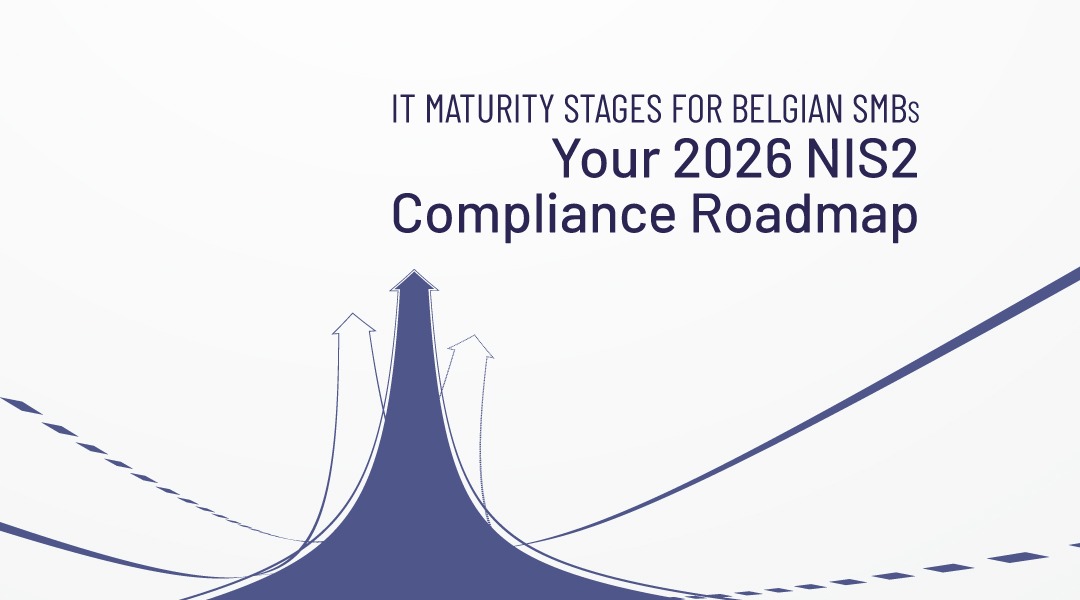
IT maturity measures how well your Belgian SMB manages technology, security, and governance. The 4 stages are: (1) Ad-Hoc IT – reactive and risky, (2) Structured IT – stable but basic, (3) Managed IT – controlled and resilient, (4) Optimized IT – strategic and automated. With the 2026 NIS2 audit cycle now in effect, most Belgian SMBs must achieve Stage 3 maturity to remain compliant and avoid significant liability.
For most Belgian small and medium-sized businesses, IT infrastructure doesn’t start with strategy—it starts with survival. You need email working by Monday, laptops for your team, and reliable internet connectivity. Over the last few years, you likely added accounting software, a customer database, cloud storage, and security tools as problems arose.
This organic growth pattern is completely normal. But it creates a hidden problem: many Belgian SMBs now find themselves with IT environments that work day-to-day but feel increasingly fragile. System changes become risky. Security vulnerabilities multiply. And with NIS2 compliance audits arriving in 2026, the gaps have become impossible to ignore.
Understanding your organization’s IT maturity level solves this problem. IT maturity isn’t just about the technology you use—it’s about how well you control, secure, and align that technology with your business goals. This guide shows you exactly where Belgian SMBs typically fall across 4 distinct maturity stages, what each stage means in practical terms, and the specific steps required to move forward safely.
What IT Maturity Actually Means for Belgian SMBs
IT maturity measures the professionalism and control your organization applies to technology management. It’s determined by five interconnected factors:
- Infrastructure quality: How reliable, standardized, and scalable your systems are.
- Process documentation: Whether changes, incidents, and operations follow repeatable procedures.
- Security posture: The depth and effectiveness of your cybersecurity measures.
- IT governance: How well technology decisions align with business strategy and regulatory requirements.
- Risk management: Your ability to identify, assess, and mitigate IT-related business risks.
Here’s what Belgian business managers need to understand: low IT maturity doesn’t automatically mean your systems are failing. Many Stage 1 organizations run surprisingly well—until something changes. A key employee leaves. A ransomware attack hits. A major client demands SOC 2 compliance. Suddenly, the gaps become critical.
Higher maturity means predictability. Systems behave consistently. Security risks are understood and managed. Problems get resolved faster. Most importantly, your IT infrastructure no longer depends on individual employees’ knowledge—it has documented structure and operational continuity.
For Belgian SMBs facing 2026 NIS2 enforcement, maturity is non-negotiable. The regulation explicitly requires Stage 3 capabilities: formalized risk management, documented policies, incident response procedures, and active management oversight. Understanding your current maturity level is the first step toward passing an audit.
Stage 1: Ad-Hoc IT (Reactive Operations)
This is where many Belgian SMBs begin. Technology exists primarily to support daily business operations, but there’s minimal structure governing how systems are managed, secured, or changed.
What Stage 1 Looks Like in Practice Your technology environment is a patchwork of different generations and vendors. The accounting software runs on an aging server. Half the team uses Windows laptops while others prefer MacBooks. Some files live on a local file server, others in personal Dropbox accounts, and critical spreadsheets sit on individual desktops.
Backups exist—probably. Someone set them up years ago, but few people know what’s actually being backed up, how frequently, or how long restoration would take if disaster struck. You’ve never tested a recovery.
Security consists of basic antivirus software and a firewall. Software updates happen when employees notice them—or when systems stop working. Security monitoring is non-existent. You typically discover problems when users report something broken, not through proactive detection.
The Real Risks in 2026 Stage 1 organizations face substantial business continuity risks:
- Unplanned downtime can extend for days when critical systems fail.
- Data loss from failed backups or ransomware can be permanent.
- NIS2 compliance is impossible without a significant infrastructure overhaul, leaving the company open to heavy fines in 2026.
Stage 2: Structured IT (Preventive Management)
In Stage 2, Belgian SMBs begin implementing structure and standardization. The primary goal shifts from reactive firefighting to preventive stability.
Key Infrastructure Changes Standardization becomes the foundation. All new laptops come from approved vendors with consistent configurations. Operating systems are standardized. File storage migrates to centralized solutions like SharePoint or Google Workspace with proper access controls.
Process Development Change management emerges, though informally. A ticketing system or service desk tracks user issues, creating visibility into recurring problems. Backup monitoring becomes active—someone verifies that backups completed, even if full restoration hasn’t been tested.
Security Improvements Access control gets better management through identity platforms like Microsoft Entra ID. Password policies are enforced, and Multi-factor authentication (MFA) is implemented for critical systems.
Business Value At Stage 2, IT becomes a reliable business function. However, for 2026 NIS2 requirements, Stage 2 still falls short of mandatory formal risk management and incident response protocols.
Stage 3: Managed IT (Controlled & Resilient Operations)
Stage 3 represents a fundamental transformation. Your IT infrastructure isn’t just stable—it’s controlled and strategically managed. This is the minimum maturity level required for NIS2 compliance in 2026.
Infrastructure & Formalized Processes System design is deliberate. Redundancy protects critical systems. Email, file storage, and applications have failover mechanisms. Change management is formal with approval workflows. Incident management follows documented procedures, and root cause analysis identifies systemic issues.
Layered Security Architecture Security evolves from prevention to defense-in-depth:
- SIEM: Centralized logging and monitoring.
- Vulnerability Management: Regular scanning and prioritized remediation.
- Awareness: Employee training is regular and measured.
- Incident Response: Procedures are documented and tested via tabletop exercises.
Business Continuity & Governance BC/DR transitions from a concept to a formalized capability. Immutable backups protect against ransomware. Governance is visible—IT policies (acceptable use, data classification) are formally approved by management.
Stage 4: Optimized IT (Strategic Excellence)
At Stage 4, technology becomes a strategic differentiator. While not strictly necessary for every SMB, organizations with high regulatory demands benefit substantially.
Infrastructure Characteristics Infrastructure is highly available and largely automated. Capacity planning uses predictive analytics. Cloud and on-premises environments integrate seamlessly.
Proactive Security & Continuous Improvement Security is intelligence-driven. Threat detection operates continuously through a Security Operations Center (SOC). Security by design governs new projects from inception.
How NIS2 Compliance Intersects with IT Maturity
In 2026, the CCB (Centre for Cybersecurity Belgium) is actively overseeing compliance. Belgian companies at Stage 1 or 2 face fundamental gaps:
- Risk Management: NIS2 requires systematic identification of risks. Stage 1/2 relies on intuition.
- Documentation: Regulations demand documented policies. Lower maturity relies on “tribal knowledge.”
- Incident Reporting: NIS2 mandates 24-hour initial reporting for significant events—impossible without Stage 3 monitoring.
NIS2 Gap-Visualizer
Visualize your compliance gaps
Quick IT Maturity Self-Assessment for Belgian SMBs
| Dimension | Stage 1: Ad-Hoc | Stage 2: Structured | Stage 3: Managed | Stage 4: Optimized |
| Infrastructure | Mixed vendors & generations. No standardization. | Standardized hardware/OS. Centralized storage. | Hybrid/cloud strategy. Redundancy for critical systems. | Highly available, automated. Infrastructure-as-code. |
| Security | Basic antivirus. Ad-hoc patching. No monitoring. | MFA for critical systems. Preventive focus. | Layered defense. SIEM monitoring. Vulnerability management. | Proactive threat hunting. SOC capabilities. Security by design. |
| Processes | Informal. No documentation. Tribal knowledge. | Basic documentation. Ticketing system. Some repeatability. | Formal change control. Asset lifecycle management. Documented procedures. | Continuous improvement. Automated workflows. Predictive analytics. |
| Governance | Minimal oversight. No IT strategy. Cost center view. | Basic policies emerging. Some management awareness. | Formal policies approved. Regular reporting. Strategic alignment. | Board-level oversight. Risk-based decision making. IT as differentiator. |
| 2026 NIS2 Audit Status | FAILED. Significant gaps. Major legal liability. | AT RISK. Foundation exists; lacks formal documentation. | COMPLIANT. Meets all 2026 Belgian audit requirements. | EXCEEDS. Compliance is integrated into automated operations. |
Advancing Your IT Maturity: Practical Steps
IT maturity progression typically requires 12-18 months per stage. For Belgian companies facing 2026 audits, this creates urgency.
The Role of ITAF ITAF partners with Belgian SMBs to bridge these gaps. We begin with a comprehensive maturity assessment to establish your baseline and identify priority gaps. Our managed services provide the infrastructure design, layered security, and governance documentation needed to reach and maintain Stage 3 or 4 maturity.
Ready to assess your current IT maturity?
Frequently Asked Questions About IT Maturity
- How long does it take to move from one stage to the next? Most Belgian SMBs require 12-18 months. Rushing creates security gaps.
- Do we need Stage 4 to be compliant? No. Stage 3 (Managed IT) is sufficient for 2026 NIS2 compliance.
- How does NIS2 relate to these stages? NIS2 mandates formal risk management and incident response, which are core Stage 3 characteristics.
- What is the typical investment range? Depending on size, Belgian SMBs typically invest €30,000-€80,000 annually for meaningful maturity advancement.